My neighbour bought an RO last Diwali. Big one. Seven-stage, mineral cartridge, the works. Her building runs on Cauvery supply. TDS of 180.
She didn’t need any of it.
That’s the thing nobody tells you when you walk into a Croma or scroll Amazon at midnight. Half the country is buying purification for water that doesn’t need that much help. The other half is skipping technology they actually do need. Picking the right ro uv uf water purifier starts with knowing what these three letters even do, separately.
Three Different Jobs, Not Three Versions Of The Same Thing
Before you compare any ro uv uf water purifier on the shelf, get this part straight. The three letters aren’t grades of the same thing, they’re three different machines doing three different jobs.
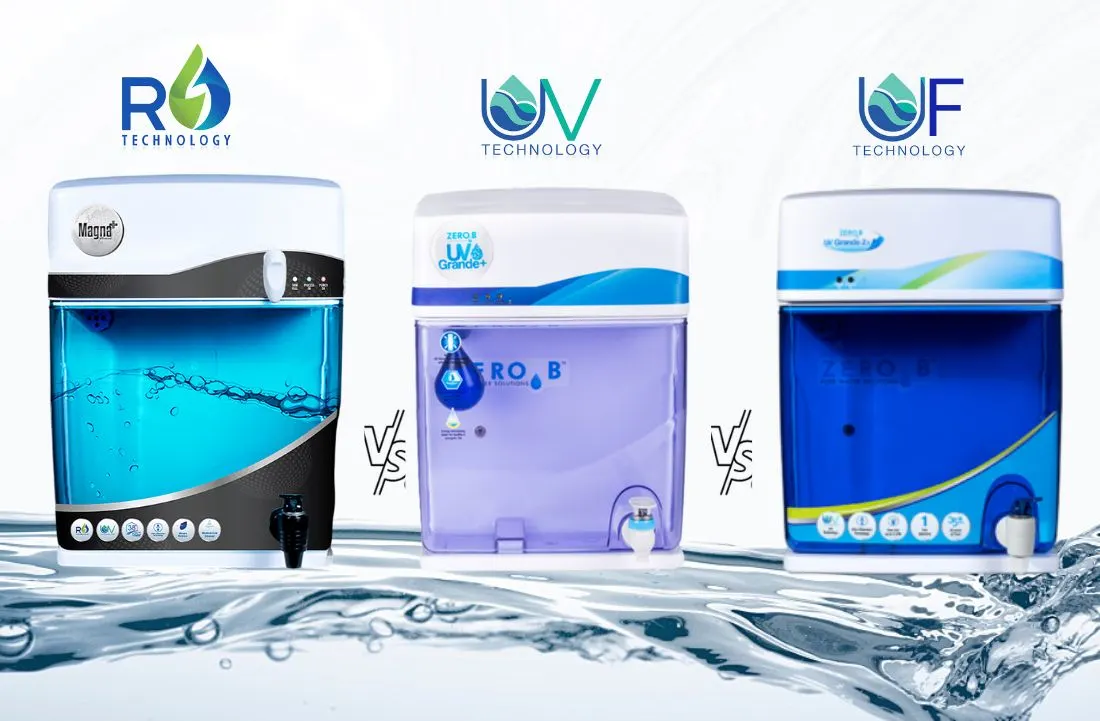
RO is Reverse Osmosis. Picture a membrane so tight that water has to be pushed through under pressure. Whatever was dissolved in it, salts, lead, traces of pesticide from farms upstream, gets pushed sideways into a reject line and out into your drain. Good news for hard borewell water. Less good if your supply is already soft, because calcium and magnesium leave with everything else.
UV doesn’t filter. There’s a small ultraviolet bulb inside that wrecks the DNA of bacteria and viruses passing through. They can’t reproduce, can’t make you sick. But anything dissolved? Still there. UV is a germ-killer, not a cleaner.
UF, ultrafiltration, blocks bigger particles. Bacteria, cysts, visible junk. Dissolved salts pass through untouched. No electricity required, which matters in cities where the power cuts out twice a day.
So: RO for salts. UV for germs. UF for bugs and dirt without a plug point. That’s it. The rest is marketing.
TDS Is The One Number You Need
Buy a TDS meter first. They cost less than a pizza.
| TDS (ppm) | What works | Reason |
| Below 200 | UV + UF | Low salts, only microbial worry |
| 200 to 500 | UV + UF, or RO if hardness is real | Borderline, your tongue decides |
| 500 to 2000 | RO + UV + UF | Salts too high to ignore |
| Above 2000 | Full system, pre-treatment | Industrial territory |
The Bureau of Indian Standards puts the upper limit for drinking water at 500 ppm. Most people start tasting something off well before that. Tea goes flat. White scale shows up on the kettle. Dal tastes a bit weird and you can’t quite say why.
Test your tap for two or three weeks before buying anything. TDS shifts with the season, especially during summer when borewell water gets mixed into the municipal line.
Where Indian Homes Get Sold The Wrong Thing
Bengaluru, on Cauvery, mostly sits at 150 to 250 ppm. RO there is selling ice to a snowman. You lose your minerals and waste roughly three litres for every one that reaches your glass. A UV-UF combo does the job and uses no extra water.
Drive up to Gurgaon, or step into west Chennai, or visit any home in Jaipur running on borewell. You’ll see TDS readings of 1200, 1500, sometimes more. Skip RO here and you’re inviting kidney problems and scaled appliances. The geyser, the washing machine, the iron, all of them age faster on hard water.
Mumbai is its own story. Low TDS year-round, but monsoon brings bacterial contamination that builds quietly. You don’t notice until the kid has a stomach bug for the third weekend in a row. UV plus UF handles it without wasting water, which matters in a city where every flat has a tank and every tank has a limit.
The pattern, if you’re paying attention, is simple. RO is for salts. If your water doesn’t have a salt problem, you’re buying a solution to a problem you don’t have.
What To Actually Check Before You Pay
A genuine ro uv uf water purifier earns its place when your source is both hard and microbially uncertain. For most other homes, parts of that stack are dead weight you’re still paying to maintain.
Quick checklist when you compare units:
- Recovery rate of 50% or better, otherwise you’re flushing more than you drink
- A mineraliser stage if RO is in the mix, otherwise the water tastes flat
- UV lamp rated for at least 8,000 hours
- Food-grade storage tank, not vague unbranded plastic
- A service network in your city, with technicians who actually show up
That last one trips up more people than anything else. A purifier you can’t service is a fancy plastic box in eighteen months.
Conclusion
The honest summary? Test your tap first. Pick the technology that matches what comes out of it, not the one with the loudest ad. The right ro uv uf water purifier isn’t the one with the most stages or the longest warranty. It’s the one that fits your water.
My neighbour’s seven-stage unit is still on her counter. She drinks half the water she used to. The other half, the reject, runs down the kitchen sink every evening while she wonders why her plants aren’t doing well.
There’s a lesson somewhere in that.