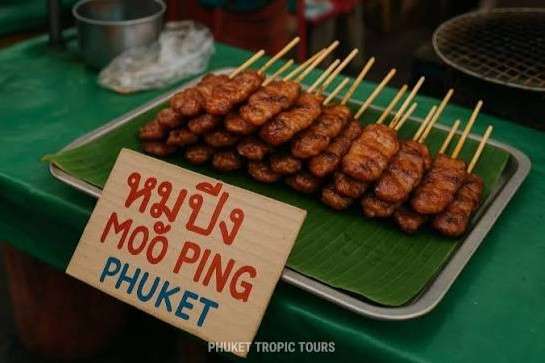
Walk through almost any morning market or busy street in Thailand and there is a good chance you will encounter the unmistakable aroma of grilled pork drifting through the air. Skewers of moo ping sizzling over charcoal are one of the country’s most recognizable street foods. Simple, affordable, and packed with flavor, moo ping has become deeply connected with everyday Thai food culture.
Although the dish appears straightforward, its history reflects the development of Thai street food itself: practical cooking methods, local ingredients, changing lifestyles, and generations of cooks adapting recipes to suit their communities.
What Does Moo Ping Mean?
The name itself is wonderfully simple. In Thai, moo means pork, while ping refers to grilling or roasting over heat. Put together, moo ping essentially means grilled pork.
The basic concept is equally uncomplicated. Pork is sliced into manageable pieces, seasoned or marinated, threaded onto skewers, and grilled over charcoal. The combination of smoke, caramelized marinade, and tender pork creates the flavor that has made moo ping so popular.
There is no single recipe that defines every moo ping. Different vendors and families have their own proportions and techniques. Some versions are sweeter, some more savory, and others emphasize garlic, pepper, coriander, or coconut milk.
This flexibility is one of the reasons moo ping has survived and evolved over generations.
The Early Roots of Grilled Meat in Thailand
Grilling meat over fire is certainly not unique to Thailand. Long before modern kitchens and gas stoves became common, cooking over charcoal or wood was one of the most practical ways to prepare meat.
Thailand’s food culture developed through centuries of interaction between different regions and communities. Trade, migration, and cultural exchange introduced new ingredients and cooking techniques, while local cooks adapted them to Thai tastes.
Grilled meat became particularly well suited to everyday life because it required relatively simple equipment. A small charcoal grill could be placed outside a home or at a market stall, allowing vendors to cook food quickly while serving customers.
Over time, skewered meats became particularly practical for street selling. They were easy to portion, easy to carry, and could be cooked continuously throughout the day.
Moo ping eventually became one of the most recognizable examples of this style of Thai cooking.
Why Moo Ping Became Popular Street Food
The growth of Thailand’s urban centers played an important role in the popularity of moo ping. As cities expanded and more people began commuting to work, convenient breakfasts and inexpensive meals became increasingly important.
Moo ping was almost perfectly suited to this lifestyle.
Vendors could prepare large quantities of marinated pork in advance, thread the meat onto skewers, and grill it as customers arrived. The skewers could be sold individually or together with sticky rice, creating a filling meal without requiring plates, cutlery, or lengthy preparation.
This convenience helped moo ping become strongly associated with breakfast and early-morning street food.
For many people, the experience is familiar: stopping at a roadside stall, choosing several smoky pork skewers, adding a small bag of sticky rice, and continuing on to work or school.
The Role of the Marinade
One of the most interesting aspects of moo ping’s development is the variety of marinades used across Thailand.
There is no universally agreed formula. Recipes can contain combinations of garlic, coriander root, white pepper, soy sauce, oyster sauce, sugar, coconut milk, and other seasonings.
This regional and personal variation is important because Thai food has traditionally been highly adaptable. Home cooks frequently adjust recipes according to available ingredients, family preferences, and local tastes.
A sweeter marinade may create a beautifully caramelized surface over charcoal, while additional garlic and pepper can produce a more aromatic version. Coconut milk can add richness and help keep the pork tender.
These differences mean that two moo ping stalls can sell skewers that look almost identical while tasting noticeably different.
Moo Ping and Sticky Rice
Moo ping’s relationship with sticky rice is another important part of its identity.
Sticky rice has long been an important staple in northern and northeastern Thai cuisine. Its convenient texture makes it easy to eat by hand and particularly suitable for pairing with grilled foods.
As grilled pork became increasingly popular across Thailand, the combination of moo ping and sticky rice became a familiar and convenient meal.
Today, the pairing is almost inseparable in the minds of many Thai consumers. The rich, slightly sweet pork contrasts naturally with the mild and chewy sticky rice, creating a satisfying meal from just two basic components.
From Traditional Stalls to Modern Kitchens
Moo ping has remained popular even as Thailand’s food culture has changed dramatically.
Modern restaurants may present it differently, while home cooks can prepare it using electric grills, frying pans, ovens, or air fryers. Online recipes have also made it easier for people outside Thailand to experiment with the dish.
Yet the fundamental idea remains unchanged: marinated pork cooked over intense heat until tender, aromatic, and lightly charred.
This ability to adapt without losing its identity is one of the defining characteristics of successful traditional foods.
Today, mooping168 continues to draw attention to the dish through recipes and ideas inspired by this Thai classic. Exploring different preparations is a useful way to understand how small changes in ingredients and cooking methods can produce completely different versions of the same beloved food.
Why Moo Ping Has Endured
The history of moo ping is ultimately a story about practicality and flavor.
It does not require expensive ingredients or complicated equipment. It can be prepared in large quantities, transported easily, eaten quickly, and adapted to different tastes. Most importantly, grilling gives the pork a distinctive aroma that attracts people before they even take their first bite.
From humble charcoal grills at neighborhood markets to modern kitchens around the world, moo ping has traveled far beyond its origins as everyday street food.
Its enduring popularity shows why traditional dishes continue to matter. They are more than recipes. They carry memories of markets, family meals, busy mornings, roadside stalls, and the familiar smell of food cooking over charcoal.
Moo ping may be just a few pieces of pork on a skewer, but its place in Thai food culture is considerably larger. It represents the practicality, adaptability, and bold flavors that have helped Thai street food become famous around the world.