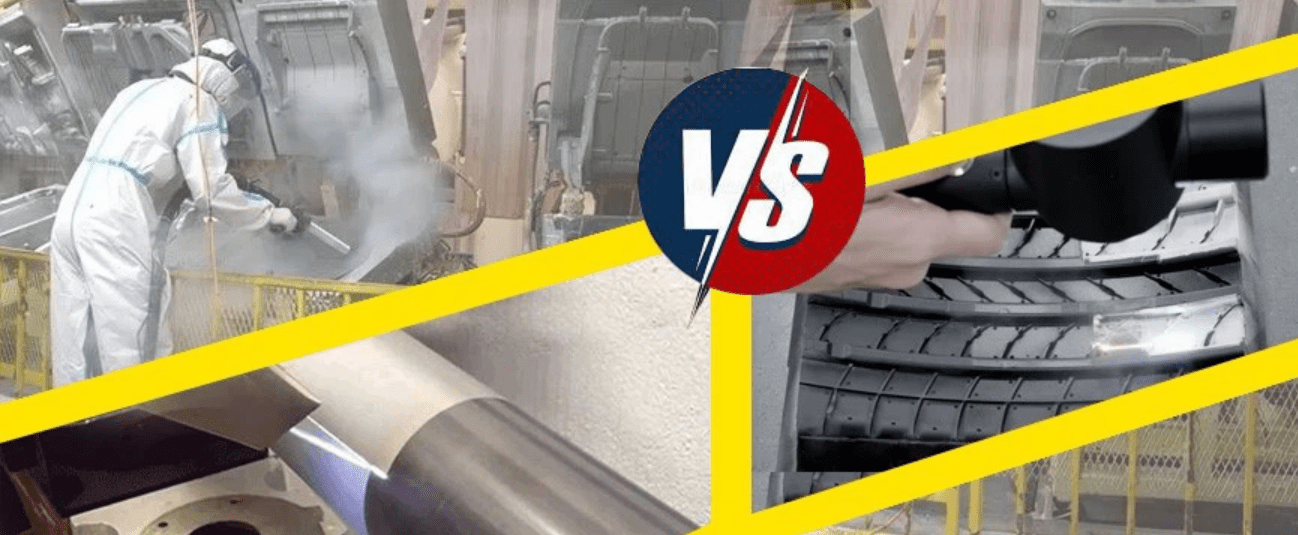
In the field of industrial cleaning, dry ice cleaning and laser cleaning are two advanced technologies that have received a lot of attention in recent years. Both can remove dirt, grease, rust, coatings, or other pollutants without relying on traditional chemical cleaners, but their working methods, application scenarios, operating costs, and cleaning effects are not the same.
There are obvious differences between these two in terms of operating range and method. Choosing the wrong cleaning method may lead to product damage and increased costs. So, how do you make a reasonable choice between these two cleaning methods?
Dry Ice Cleaning and Laser Cleaning Comparison
| Comparison Item | Dry Ice Cleaning | Laser Cleaning |
| Working Principle | Uses compressed air to spray dry ice pellets at high speed, removing pollutants through impact, thermal shock, and sublimation. | Uses a high-energy laser beam to act on the pollution layer, causing it to evaporate, peel off, or decompose. |
| Surface Contact | Has some physical impact. | Usually non-contact cleaning. |
| Cleaning Precision | Medium; better for larger areas. | High; suitable for fine and local cleaning. |
| Cleaning Speed | Fast for large areas. | High efficiency for local treatment; usually slow for large-area work. |
| Consumables | Needs a continuous supply of dry ice. | Generally no traditional consumables. |
| Secondary Waste | Dry ice itself sublimates, but the removed pollutants still need to be handled. | Mainly removed pollutants and a small amount of dust. |
| Surface Impact | Generally mild, but still has physical effects. | More suitable for scenarios with high precision and surface protection requirements. |
| Initial Equipment Cost | Usually lower. | Usually higher. |
| Long-term Operating Cost | Buying, transporting, and storing dry ice increases long-term costs. | High initial investment, but long-term consumable costs are lower. |
| Typical Applications | Production lines, molds, food equipment, large machinery. | Rust removal, paint removal, weld cleaning, precision parts, metal surface treatment. |
What is Dry Ice Cleaning?
Dry ice cleaning is an industrial cleaning method that uses solid carbon dioxide pellets for surface treatment. During cleaning, the equipment sprays dry ice pellets at high speed onto the surface through compressed air. After the dry ice pellets hit the pollution layer, they create multiple effects, including mechanical impact, thermal shock caused by temperature differences, and volume changes when the dry ice sublimates, which loosens the pollutants and makes them fall off the surface.
A clear feature of dry ice cleaning is: dry ice sublimates quickly after touching the surface and does not leave a large amount of spray media residue like sandblasting. This is one of the reasons why it is popular in food processing, mold cleaning, rubber, plastic, printing, and some manufacturing fields. Although the dry ice itself disappears after cleaning the items, the removed oil, dirt, and pollution layers still exist and need manual handling afterward. This will increase the cost after cleaning.
What is Laser Cleaning?
Laser cleaning is a technology that uses high-energy laser beams to remove surface pollutants. Its core principle is to let the pollution layer absorb laser energy, which then leads to evaporation, peeling, thermal decomposition, or vibration detachment, while the substrate itself is affected as little as possible.
Compared with dry ice cleaning, laser cleaning is usually considered more suitable for jobs with high precision, localization, and high controllability requirements. For example, metal surface rust removal, laser weld cleaning, using lasers to remove oxide layers, precision mold cleaning, and laser local coating removal. Laser cleaning often provides better control.
Laser cleaning machine do not rely on traditional consumables. Unlike dry ice cleaning, it does not produce a lot of pollutant residue after cleaning. This is an advantage of laser cleaning, which can save costs and the use of labor. It’s just that the initial cost of buying a laser cleaning machine is higher.
Differences Between Dry Ice Cleaning and Laser Cleaning
1. Different Cleaning Methods
Dry ice cleaning is essentially a method of peeling off pollutants with the help of pellet spraying, which has a certain physical impact. During cleaning, it may cause some damage to the substrate surface. It is more like a combination of “high-speed media + temperature difference + sublimation effect.”
Laser cleaning removes pollutants through the interaction between light energy and the pollution layer, which is more like “selective energy treatment.” The laser cleaning machine can more accurately control the heat, cleaning range, and cleaning speed during operation.
2. Different Precision
The laser beam from the laser cleaning machine head can focus precisely on a small area. Operators can better control the cleaning depth, area, and position. Laser cleaning is commonly used for: metal rust removal, precision part treatment, and cleaning before and after welding. Dry ice cleaning is suitable for handling large-area equipment or overall polluted surfaces, and its precision requirement is much lower than laser cleaning.
3. Different Efficiency for Large Areas
In scenarios with large-area heavy rust or heavy pollution, dry ice cleaning is generally the first choice. In this case, the requirement for surface precision after cleaning is not that high, and fast cleaning is required. Laser cleaning cannot achieve this in such scenarios. Even using a 6000W continuous laser cleaning machine cannot meet the requirements because the scanning range of the laser head is limited. Even high-power cleaning machines cannot compare with dry ice cleaning.
In this scenario, the advantage of dry ice cleaning is that it can clean large areas quickly and save time. However, in this situation, you must be careful that long-term use may cause carbon dioxide to gather and harm the human body. It must be used in an open area with good ventilation. At the same time, pay attention to the stable operation of the equipment, as long-term operation may damage the dry ice cleaning equipment.
4. Different Impact on Surfaces
Although dry ice cleaning is a relatively mild cleaning method, it still produces pellet impact when sprayed, making it unsuitable for all surfaces. Laser cleaning is used on more surfaces than dry ice cleaning. Especially when the parameters are controlled correctly, it can not only achieve fast surface cleaning but also reduce damage to the substrate. (Please note: It’s not that laser cleaning causes zero damage to the substrate surface, but compared to dry ice cleaning, the damage can be ignored, and laser cleaning can be precisely controlled through parameters.)
5. Different Consumables and Supply Chain Requirements
Dry ice cleaning requires a continuous supply of dry ice pellets, which have the following characteristics:
Needs regular purchase, high storage requirements, needs planned transportation and supply, and will lose volume through sublimation during long-term storage. This means that dry ice cleaning is not just about buying equipment; it also involves supply chain management in continuous operation.
Laser cleaning usually does not depend on traditional cleaning media, so the consumable management is lighter. For companies that want to reduce long-term supply pressure and storage difficulty, this is a clear advantage.
6. Different Waste Treatment
Dry ice cleaning itself does not leave media, but there will be residue from the removed pollution layer: oil, carbon deposits, rust chips, or peelings still need to be collected and handled. Although laser cleaning also produces pollutants, they are basically smoke or dust. You only need to keep the area ventilated, and no secondary treatment is needed.
Compared to each other, laser cleaning is easier to achieve fine control in some high-cleanliness scenarios, while dry ice cleaning focuses more on overall efficiency in heavy pollution environments.
7. Different Safety Requirements
Dry ice cleaning needs to focus on:
Low-temperature contact risk, high-speed pellet impact, operating noise, ventilation conditions, and carbon dioxide accumulation risk.
Laser cleaning needs to focus on:
Laser radiation protection, reflection risk, smoke control, and requirements for operating parameters and equipment standards.
8. Different Cost Structures
From the perspective of buying equipment, dry ice cleaning machines are usually easier to get started with, while the initial investment for laser cleaning machines is usually higher.
But if you look at long-term operation, the situation is more complex.
The long-term cost of dry ice cleaning comes from: dry ice consumables, storage and transportation, compressed air consumption, labor, and maintenance.
The long-term cost of laser cleaning comes from: initial equipment investment, equipment maintenance, dust removal equipment in some scenes, and operation training.
From a long-term investment analysis, buying a laser cleaning machine is more advantageous than dry ice cleaning. Laser cleaning is a complete process that does not need extra consumables; you only need to ensure the machine runs stably to finish the cleaning.
When is Dry Ice Cleaning More Suitable?
- Large equipment and large-area surface cleaning: Such as production line equipment, conveyor systems, mold exteriors, and large mechanical structures.
- Hope to reduce disassembly time: Many companies choose dry ice cleaning because it supports cleaning equipment in place to some extent, reducing disassembly steps and downtime.
- Thick or heavy pollution layers: For grease, carbon deposits, some production residues, and heavy-duty equipment surfaces.
- Food processing and some manufacturing scenes: In industries with limits on chemical cleaners, dry ice cleaning is more easily adopted because it doesn’t use traditional chemicals.
When is Laser Cleaning More Suitable?
- High-precision local cleaning: When you only need to handle one area and don’t want to affect the surrounding surface.
- Metal rust removal and oxide layer removal: Widely used in metal surface treatment, cleaning before and after welding, and precision rust removal.
- Sensitive surfaces or high-value workpieces: For precision parts, thin-walled parts, mold details, or workpieces with high surface requirements.
- Want to reduce long-term dependence on consumables: For companies that don’t want to keep buying and storing cleaning media, laser cleaning is usually easier in long-term management.
Which One is Better: Dry Ice Cleaning or Laser Cleaning?
We cannot say which method is better without a specific working condition and scene. Both are preferred solutions for cleaning. If you are facing large areas, heavy pollution, negligible surface damage, and need fast on-site cleaning: dry ice cleaning is preferred. If you value high precision, local treatment, metal rust removal, and fine surface cleaning, HANTENCNC suggests giving priority to laser cleaning. The final decision on which cleaning method is better or which one to choose first should be decided by the specific working conditions and usage scenarios together.
Conclusion
Both dry ice cleaning and laser cleaning are very valuable cleaning technologies in modern industry, but they do not solve the same problems. When deciding whether to buy a laser cleaning machine or a dry ice cleaning machine, you must be clear: What material are you cleaning? What type of pollutant is it? Is it a large area or a local treatment? Do you need high precision? Do you want to reduce consumables? Is your downtime cost high? The truly good choice is always the one that fits your production scene best.
FAQ
Is dry ice cleaning better than laser cleaning?
Not necessarily. Dry ice cleaning is more suitable for large-scale and heavy-pollution equipment, while laser cleaning is more suitable for high-precision and local treatment. Which one is better depends on the actual application.
Is laser cleaning more accurate than dry ice cleaning?
Usually, yes. Laser cleaning often has more advantages in local control, handling fine areas, and reducing the impact on surrounding areas.
Does dry ice cleaning damage the surface?
In many applications, dry ice cleaning is considered relatively mild, but because of the pellet impact, not all sensitive surfaces are suitable. It is best to do a parameter test before official use.
Is laser cleaning suitable for rust removal?
Yes. Laser cleaning is commonly used for metal surface rust removal, oxide layer removal, weld cleaning, and local coating treatment.
Does dry ice cleaning leave no waste?
Dry ice itself sublimates and leaves no spray media residue, but the pollutants removed still need to be collected and handled.
Which method has a lower long-term cost?
This depends on the usage frequency and cleaning scene. Laser cleaning has a higher initial investment, but long-term consumable costs are lower. Dry ice equipment may have a lower entry cost, but it adds consumable and supply chain costs in the long run.
Which industries use both dry ice and laser cleaning?
Industries like food processing, car manufacturing, mold industry, metal processing, aerospace, equipment maintenance, and industrial manufacturing may use both technologies at the same time based on different workpiece and process needs.